Ultimate Guide to ISO 80369 Taper Reference Connectors and Gauges: Ensuring Patient Safety in Medical Devices
In the rapidly evolving field of medical device manufacturing, ensuring compatibility and preventing misconnections remains a top priority. The ISO 80369 series of standards has revolutionized small-bore connectors by introducing engineered designs, including the critical 6% taper, to eliminate risks associated with traditional Luer fittings. This comprehensive technical blog explores ISO 80369 taper reference connectors and gauges, with a special focus on solutions from manufacturers like Medzus Healthcare.
Whether you're a biomedical engineer, quality assurance professional, regulatory expert, or medical device manufacturer, understanding these reference tools is essential for compliance, testing, and validation. We'll cover the standards' history, technical specifications, applications across ISO 80369 parts, gauge design principles, testing methodologies, and practical insights from industry leaders.
Introduction to ISO 80369 Standards
The ISO 80369 series replaces and expands upon the older ISO 594 standards for Luer connectors. Introduced to address patient safety concerns, the series defines small-bore connectors for liquids and gases in healthcare applications. These connectors prevent tubing misconnections that could lead to serious adverse events, such as delivering enteral nutrition intravenously or injecting medication into the wrong route.
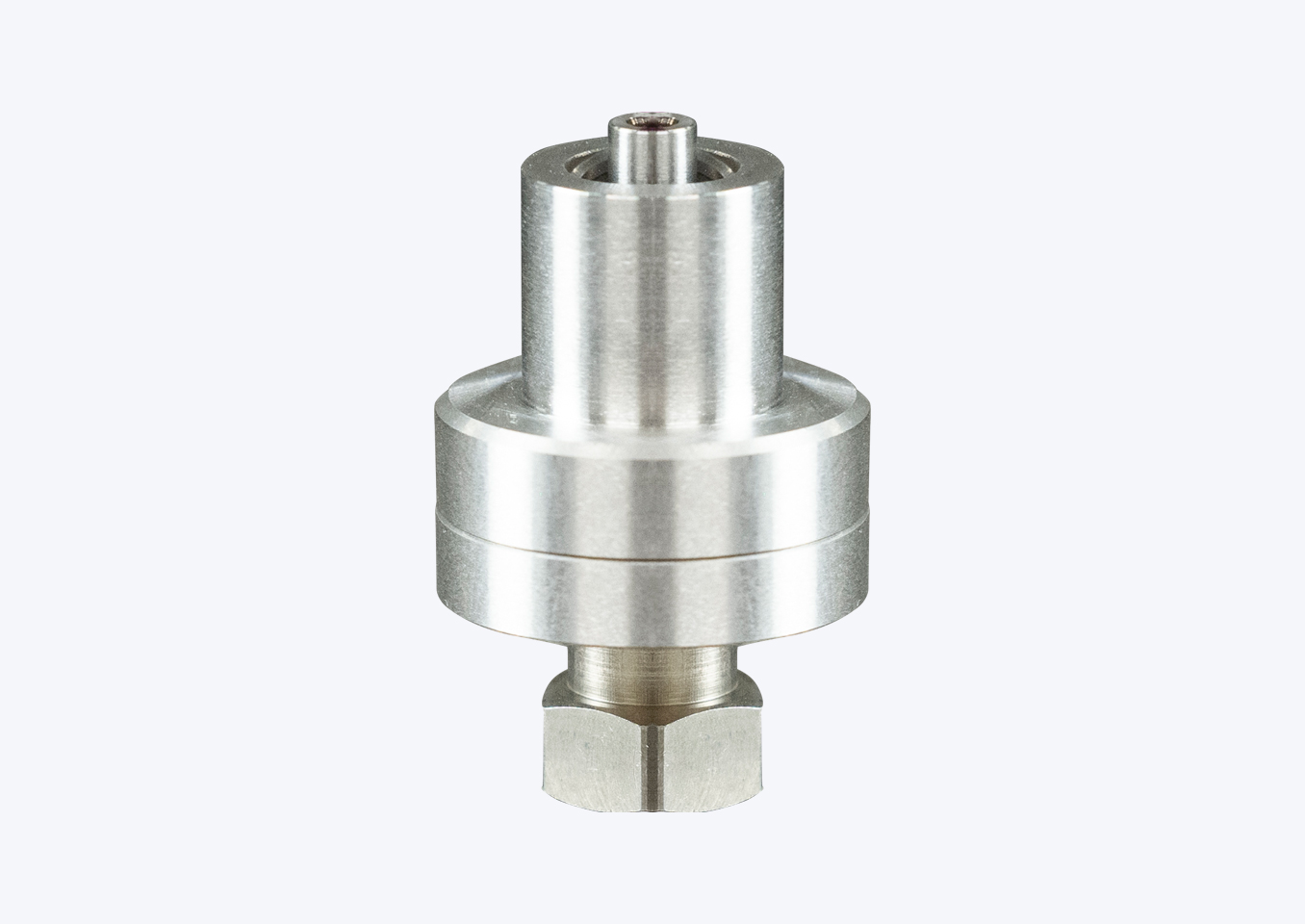
Small-bore connectors are used in devices like syringes, catheters, infusion lines, ventilators, and feeding tubes. The core innovation is the 6% taper (a 6% reduction in diameter over a defined length), which ensures connectors only mate with compatible counterparts.
Why the Shift from ISO 594 to ISO 80369?
Traditional Luer connectors (ISO 594) allowed cross-connections across applications, leading to errors. The ISO 80369 series creates application-specific connectors, reducing risks. For example:
• ISO 80369-7 maintains a 6% Luer taper for intravascular use but adds stricter performance requirements.
• Other parts introduce unique geometries to block incompatible connections.
This evolution enhances patient safety, regulatory compliance (FDA, EU MDR), and manufacturing reliability.
Understanding the 6% Taper Design
The 6% taper is the hallmark of Luer-compatible connectors. It refers to a conical shape where the diameter decreases by 6% per unit length (typically 0.06 mm/mm). This taper ensures:
Secure friction fit (slip connection).
Threaded lock mechanisms (Luer lock).
Leak-proof seals under pressure.
Reference connectors and gauges verify this taper during manufacturing and quality control. Gauges are precision tools, often made from hardened stainless steel, used to check dimensional accuracy.
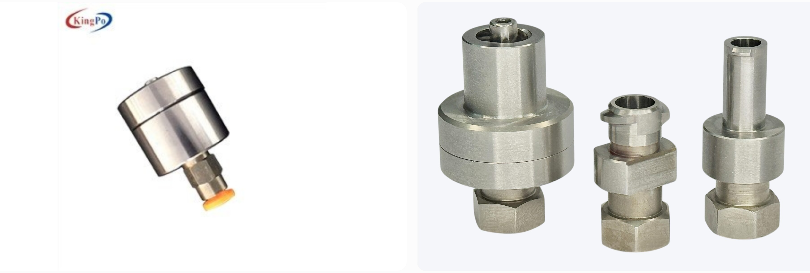
These images show typical reference connectors with the 6% taper profile, often featuring male plugs or female sockets with calibration markings.
Key Dimensions in 6% Taper Connectors
Typical specifications (from ISO 80369-7):
Male cone length: Approximately 7.5 mm to 10 mm.
Taper angle: ~1.72° (corresponding to 6%).
Reference diameter at base: Varies by part (e.g., 4.315 mm for certain Luer sizes).
Gauges incorporate go/no-go features to ensure connectors meet tolerances.
Overview of ISO 80369 Parts
The ISO 80369 series includes multiple parts, each targeting specific clinical applications. Here's a summary table:
| ISO Part | Application Area | Connector Type | Key Purpose | Common Devices |
|---|---|---|---|---|
| ISO 80369-1 | General Requirements | N/A | Common test methods, misconnection prevention | All small-bore connectors |
| ISO 80369-2 | Breathing Systems & Anaesthetic | Unique geometry | Prevent cross-connection with IV/enteral | Ventilators, anesthesia machines |
| ISO 80369-3 | Enteral Feeding | ENFit design | Block IV/respiratory misconnections | Feeding tubes, enteral syringes |
| ISO 80369-4 | Urological | Specific taper/locking | Avoid connection to other systems | Urinary catheters, drainage bags |
| ISO 80369-5 | Limb Cuff / Blood Pressure | Unique profile | Prevent fluid/gas mix-ups | Blood pressure cuffs |
| ISO 80369-6 | Neuraxial | Non-Luer taper | Reduce spinal/epidural errors | Epidural catheters, spinal needles |
| ISO 80369-7 | Intravascular/Hypodermic | 6% Luer taper (slip/lock) | Maintain legacy compatibility with added safety | IV lines, syringes, hypodermic needles |
This table highlights how each part uses tailored designs to enhance safety.
Detailed Breakdown of Key Parts
ISO 80369-7: Intravenous and Hypodermic Connectors (Luer)
ISO 80369-7 is the most widely used part, replacing ISO 594. It specifies:
6% taper for conical fittings.
Performance tests for leakage, separation force, stress cracking, and overriding resistance.
Reference connectors (male/female slip and lock) for calibration.
KINGPO provides ISO 80369-7 Luer slip and lock reference connectors to test compliance.
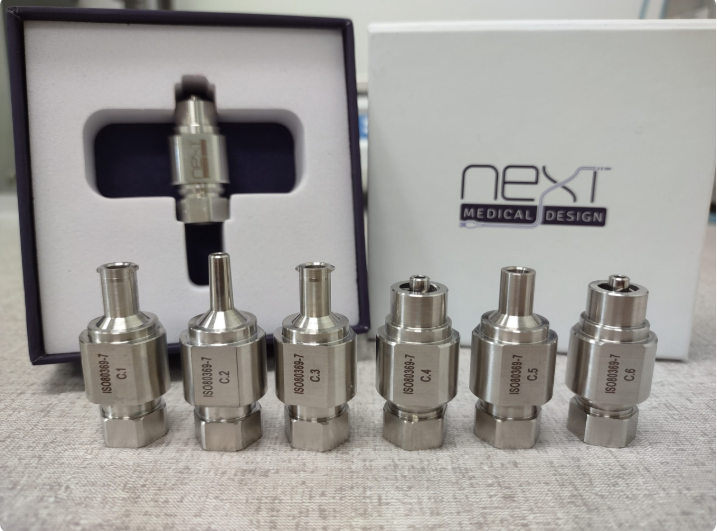
ISO 80369-7:2021 Reference Connector
This image displays a set of ISO 80369-7 reference connectors (C.1 to C.6), typically used for dimensional verification.
ISO 80369-3: Enteral Connectors
ENFit connectors feature a unique male/female design with locking rings to prevent IV misconnections. Medzus offers reference connectors and gauges for enteral testing.
ISO 80369-6: Neuraxial Connectors
These non-Luer connectors minimize risks in spinal anesthesia. Gauges ensure precise fit without cross-compatibility.
Reference Connectors and Gauges: Purpose and Design
Reference connectors are master standards (often stainless steel) used to verify production connectors. They simulate real-world fit, torque, and pressure.
Gauges include:
Go/No-Go gauges: Pass/fail dimensional checks.
Taper plug/ring gauges: Verify cone angle and diameter.
Thread gauges: For Luer lock threads.
Materials: Corrosion-resistant stainless steel (e.g., 316L) for durability and accuracy.
How Gauges Are Used in Testing
Dimensional Verification: Insert connector into gauge.
Functional Testing: Apply axial force, torque, and pressure.
Misconnection Tests: Attempt incompatible connections.
KINGPO emphasizes steel reference connectors for calibration in labs and regulatory testing.
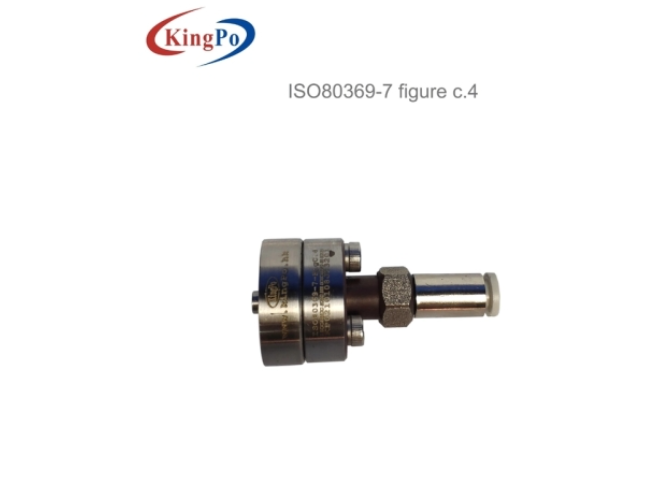
This gauge example shows a combined taper and thread checker for ISO 80369-7
KINGPO Healthcare's Solutions for ISO 80369
Medzus Healthcare Pvt. Ltd. specializes in ISO 80369-compliant reference connectors and gauges. Their offerings include:
6% taper reference connectors for all ISO 80369 parts.
Precision-manufactured gauges for hypodermic, enteral, neuraxial, and other applications.
Downloadable technical documents (e.g., ISO 80369-7 Luer reference connectors PDF).
Medzus products are designed for high accuracy, supporting manufacturers in design validation, quality control, and regulatory submissions.
Key benefits:
Compliance with global standards.
Reduced risk of misconnections.
Reliable performance in harsh testing environments.
For detailed specifications, visit their page on ISO 80369 Taper Reference Connectors & Gauges.
Testing Methods and Compliance Requirements
ISO 80369-20 defines common test methods (Annexes B-I), including:
Leakage under pressure.
Resistance to overriding.
Stress cracking.
Disconnection by unscrewing.
Equipment often includes universal fixtures with reference connectors.
Comparison: ISO 594 vs. ISO 80369-7
| Aspect | ISO 594 | ISO 80369-7 |
|---|---|---|
| Taper | 6% Luer | 6% Luer with tighter tolerances |
| Torque Range | Broader | Narrower for consistency |
| Misconnection Prevention | Limited | Enhanced via application-specific parts |
| Gauge Compatibility | Legacy gauges acceptable | New reference connectors required |
These changes improve reproducibility.
Benefits of Using Proper Taper Gauges
Patient Safety: Prevents life-threatening misconnections.
Regulatory Compliance: Meets FDA 510(k), EU MDR, and ISO 13485 requirements.
Manufacturing Efficiency: Early detection of defects.
Cost Savings: Reduces recalls and liability.
Common Challenges and Solutions
Challenges:
Legacy equipment incompatibility.
Tolerance stack-up in plastic molding.
Calibration drift.
Solutions:
Use certified reference connectors (e.g., Medzus).
Regular gauge calibration.
Implement statistical process control.
Future Trends in Small-Bore Connectors
Emerging technologies include smart connectors with RFID, advanced materials for biocompatibility, and integration with digital health systems. The ISO 80369 series will likely evolve to cover new applications like wearable drug delivery.
Conclusion
ISO 80369 taper reference connectors and gauges are indispensable for safe medical device development. By adhering to these standards and using precision tools from trusted providers like Medzus, manufacturers can ensure compatibility, performance, and patient safety.
- KINGPO will meet you at the 92nd China International Medical Equipment (Autumn) Expo in 2025
- What are the key differences between ISO 80369-7 and ISO 594?
- ISO 80369-7 Luer Gauge Checklist
- KINGPO Company Unveils Next-Generation Electrosurgery Analyzer
- KINGPO 2024 R&D Results Report
- ISO 594 is replaced with ISO 80369
- ISO 80369-7:2016 Connectors with 6% (Luer) taper for intravascular or hypodermic applications What is the ISO 80369-7 standard? What happened to ISO 594-1 and ISO 594-2?
- Saudi Arabian Customer Purchase ISO 80369-7 reference connector and ISO 80369-20 test apparatus from us
- Understanding the Importance of Buying a Luer Connection Test Kit
- Essential Considerations for Small-Bore Connector Testing Equipment